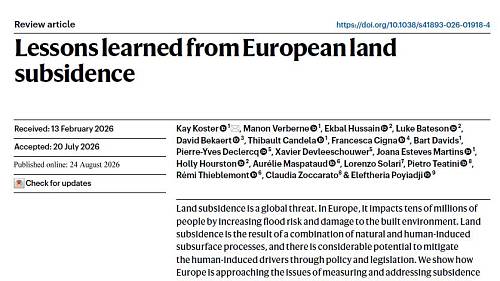
A new study published in Nature Sustainability highlights the growing importance of understanding and addressing land subsidence across Europe, as climate change and the energy transition place new pressures on the subsurface.
Bringing together expertise from across the continent, the study reviews how Europe monitors and addresses the gradual sinking of the Earth’s surface and identifies priorities for improving preparedness and supporting evidence-based mitigation and adaptation.
Land subsidence can result from groundwater and hydrocarbon extraction, mining and other human activities, as well as natural processes. Its consequences range from damage to buildings and infrastructure to reduced aquifer storage capacity and increased relative sea-level rise.
European cooperation turns national experience into shared knowledge
The study highlights the importance of collaboration across Europe. Countries have developed considerable expertise in different subsidence processes over recent decades, from coal mining in Poland and groundwater extraction in Greece and Italy to glacial isostatic adjustment in Scandinavia and the Baltic region.
Sharing this knowledge across borders can help countries anticipate and address challenges for which they may have less experience. Common data standards and European-scale data infrastructure are central to this effort, helping to identify land subsidence hotspots and improve understanding of processes that extend across national borders.
Climate change and the energy transition bring new challenges
The authors also point to emerging challenges. More frequent and intense droughts could increase groundwater demand while reducing aquifer recharge, while hotter and drier summers can increase ground movement in areas with susceptible soils.
At the same time, Europe’s transition towards net-zero emissions is bringing new uses of the subsurface. Geothermal energy, carbon capture and storage and underground hydrogen storage can all cause ground movement, creating a growing need to understand how new activities interact with existing subsidence processes.
As Europe’s subsurface is used more intensively for water, energy, storage, infrastructure, and resources, distinguishing between the different causes of ground movement will become increasingly important. The study points to the potential of combining satellite and ground-based observations with geological, groundwater and reservoir information and physics-based models to support more reliable predictions and better-informed management decisions. With growing volumes of data available at European scale, the future application of these techniques is becoming increasingly promising.
From European collaboration to new research
The publication emerged from work within the Geological Service for Europe (GSEU) project and was further developed through a joint UNESCO Land Subsidence International Initiative and EuroGeoSurveys workshop on European land subsidence, held in Brussels in 2025.
The research demonstrates how European cooperation, shared geological knowledge and increasingly harmonised data can help Europe better understand and anticipate land subsidence as climate change and new uses place growing demands on the subsurface.
"Lessons Learned from European Land Subsidence" is published in Nature Sustainability.
Back