Genetic Model Variability of Deep-Sea Phosphorites Along the Iberian–North African Margins Evidenced by In Situ Geochemistry and Isotopic Signatures

June 23, 2026

Decrée, S.; González, F.J.; Marino, E.; Santofimia, E.; Magalhães, V.H.; Coint, N.; Mansur, E.T.; Baele, J.-M.; Deloule, E. Genetic Model Variability of Deep-Sea Phosphorites Along the Iberian–North African Margins Evidenced by In Situ Geochemistry and Isotopic Signatures. Minerals 2026, 16, 661. https://doi.org/10.3390/min16060661 

Abstract

Phosphorites are a vital source of phosphorus for agricultural and industrial applications and are increasingly recognized for their potential as secondary repositories of critical raw materials (CRMs) such as rare earth elements plus yttrium (REYs). This study investigates deep-sea phosphorites from the Galicia Bank, Madeira, and Canary Seamounts, in the NE Atlantic Ocean, which are spatially associated with ferromanganese (Fe-Mn) mineralization. Through integrated petrographic, geochemical, and in situ isotopic analyses (O and Sr), we assess the timing, processes, and paleoenvironmental conditions of phosphogenesis and its implications for CRM enrichment. Rare earth element patterns in apatite reflect a predominant seawater-derived signature with variable Ce anomalies. Nevertheless, variable Y/Ho ratios point to evolving fluid sources including a hydrogenous component (directly derived from seawater), modified porewaters and, locally, volcanic or possibly hydrothermal inputs. Oxygen and strontium isotope compositions constrain phosphogenesis to several episodes ranging from the Upper Cretaceous to the Middle Miocene, with distinct isotopic shifts identifying both primary formation and later overprinting processes mostly linked to Fe-Mn oxyhydroxide growth or volcanic–hydrothermal activity. These findings highlight the dynamic and multiphase nature of phosphorite formation in deep-marine settings. The integration of high-resolution geochemical and isotopic tools proves essential for reconstructing genetic histories, defining metallogenic context and evaluating CRM prospectivity in complex submarine systems. 

Keywords

Galicia Bank; Tropic Seamount; Seine Seamount; phosphorite; phosphogenesis; apatite; post-depositional processes; rare earth elements; Sr and O isotopes
Back
July 8, 2026

Europe has set ambitious goals for Critical Raw Materials. Achieving them starts with understanding Europe's geology, long before investment decisions are made, permits are issued, or exploration begins. Better geological knowledge reduces uncertainty, strengthens decision-making, and reveals Eur...

Show post on LinkedIn
July 3, 2026

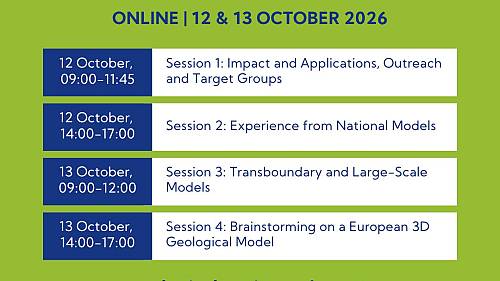
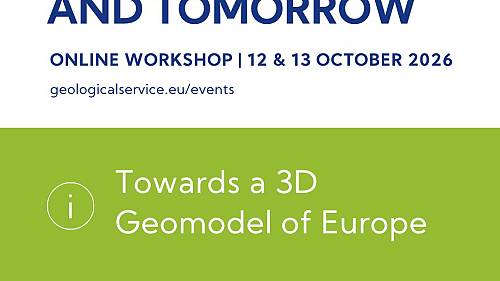
Before you switch on your out-of-office, take a moment to save the date! 𝐖𝐨𝐫𝐤𝐬𝐡𝐨𝐩: 𝐓𝐨𝐰𝐚𝐫𝐝𝐬 𝐚 3𝐃 𝐆𝐞𝐨𝐦𝐨𝐝𝐞𝐥 𝐨𝐟 𝐄𝐮𝐫𝐨𝐩𝐞 📅 12-13 October 2026 | Online Expect discussions on national and transboundary 3D geological modelling initiatives, and on the path towards a harmonised European 3D geomodel. More in...

Show post on LinkedIn
June 30, 2026

🌱 Great projects don't stand alone. CO2SITE, a new Horizon Europe project, builds on the expertise, network and results developed through GSEU to advance an open-access atlas of potential CO₂ storage sites across Europe, demonstrating how European research and collaboration can deliver lasting se...

Show post on LinkedIn
June 25, 2026

💧 As Europe accelerates the digitalisation of the water sector, groundwater cannot remain out of sight. Through the GSEU - Geological Service for Europe project, Geological Survey Organisations have established the 𝐄𝐮𝐫𝐨𝐩𝐞𝐚𝐧 𝐆𝐫𝐨𝐮𝐧𝐝𝐰𝐚𝐭𝐞𝐫 𝐌𝐨𝐧𝐢𝐭𝐨𝐫𝐢𝐧𝐠 𝐃𝐚𝐭𝐚𝐛𝐚𝐬𝐞, proving that a harmonised, interoperable...

Show post on LinkedIn
June 24, 2026

June was so packed with geothermal action that we're calling it Junethermal. Our partners contributed to major discussions on the future of geothermal energy at: ♨️ International Energy Agency (IEA) and Carnegie Europe's roundtable, Geothermal Energy for Europe: Scaling from Niche to Mainstream ♨...

Show post on LinkedIn
June 18, 2026

💭 Imagine waking up in a Europe where the minerals behind everyday life have vanished. No smartphones, no laptops, no vehicles, no infrastructure... the list goes on and on. A fictional scenario, but a very real challenge: access to minerals, particularly critical raw materials, is essential for ...

Show post on LinkedIn